
One of the most amazing experiences I’ve ever had in the theatre is getting to play Medea in Euripides’ legendary tragedy. I got to work with the incredible Kevin Landis, and alongside such talents as Seth Lindsey, Sierra Tune, and Matt Phillips.

Our production took place in March of 2021, when COVID-19 was still a very active threat. Kevin Landis used restrictions to make brilliant artistic choices, where the chorus was masked and anonymous, while the royal characters lived safe and sound in mobile boxes (pictured here). Medea, not fitting in anywhere, moved in and out of her box.
Medea is an amazing and harsh character. I’m often in comedic or ingenue roles, so figuring out Medea was a completely different experience.
If anyone doesn’t know the story of Medea, I’ll summarize it as briefly as possible. (Buckle up.) One of the great heroes of Greek mythology was Jason, the rightful heir of the city Iolcus. His uncle overthrew his father, and several years later, Jason was tasked to retrieve the Golden Fleece in exchange for his throne. The Golden Fleece was closely guarded in Colchis, where Medea was a princess and sorceress. She fell in love with Jason and helped him take the Fleece. They ran away together, Medea brutally killing her brother in the escape. In Iolcus, Medea brought about the usurping uncle’s death, and so she and Jason were driven out. They settled in Corinth for ten years, during which they had two sons. But that’s all backstory.
The play opens when Jason is about to marry the princess of Corinth and drive Medea out the city. Medea begs Creon, the king, to allow her one more day before she is driven out, and he concedes. Medea and Jason argue over the circumstances, particularly over the fate of their children. Medea, desperate to not become homeless, begs her old friend Aegeus to grant her asylum in his city of Athens, and he agrees. This safety in place, Medea plots to take revenge on Jason and Creon by killing Creon and his daughter, as well as her two sons. Her plan goes perfectly, and she drags away her sons’ dead bodies to be taken away by a flying chariot.
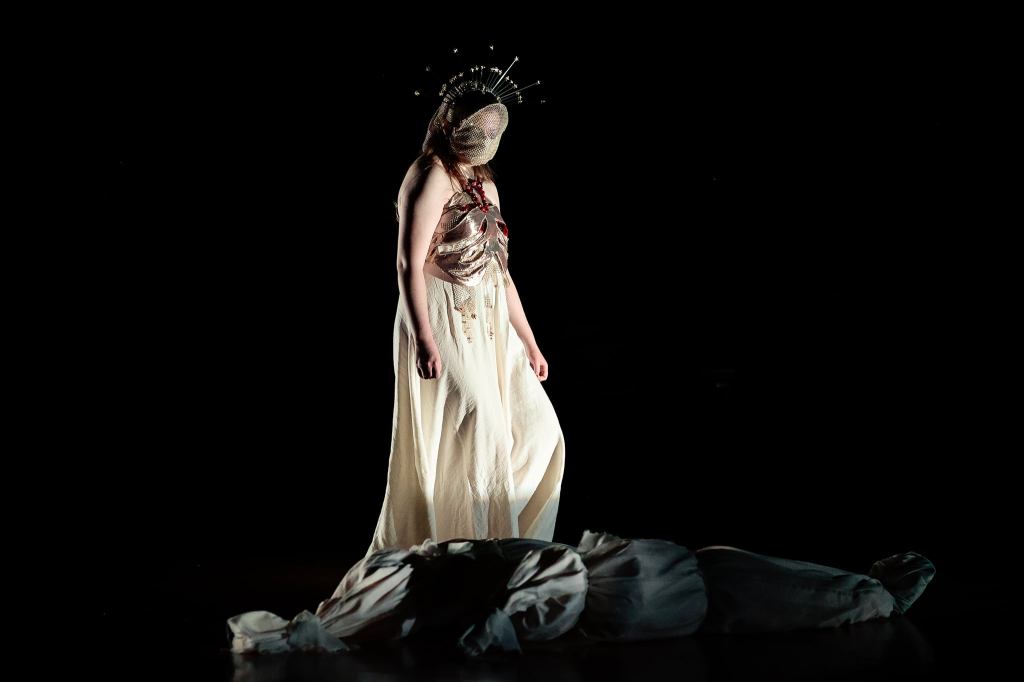
I started working on Medea from the idea of a jilted lover, thinking of how she was heartbroken and lashing out because of jealousy. In the script, she expresses her anger through a series of points and arguments. One of the ways I worked on her was building a playlist that she might have listened to, something that would help me get into her mindset and emotional/ physiological state. My favorite jilted lover song of all time is “Burn” from Hamilton, so naturally it was first in my list. I also had a CD of Hamilton that was permanently in my car, so I listened to that as I headed to rehearsals and performances. It was a while before I realized that Medea wasn’t as present in “Burn” as she was in the cabinet battles. (Considering the arguments and the poetry, the scenes between her and Jason could easily be rewritten into rap battles.) She is a furious and brilliant woman, and her anger is as politically justified as it is emotionally.
The greatest connection and sympathy I have for Medea is that the core of her identity is not the cast-away lover, but the betrayed foreigner. Medea was a princess in her own land, the most powerful and respected woman in her country; in Corinth, however, she is regarded as a heathen, a less-than, an “other”. Her identity as a foreigner is the actual core of the entire play. Medea was a drag on Jason’s social and socioeconomical status, leading him to marry Creon’s daughter. When Creon decides to banish Medea, Medea’s main obstacle is set in place: she has nowhere to go. She sacrificed her home and family (literally) for Jason, she stained her reputation and made enemies everywhere on his behalf. Whether it was love or ambition (or, in my opinion, both), she tied her identity and future to Jason. In the words of another B.C.E. woman, “Where you go I will go, and where you stay I will stay…Where you die I will die, and there I will be buried.” Jason repaid her devotion by casting her out of the last home she had.
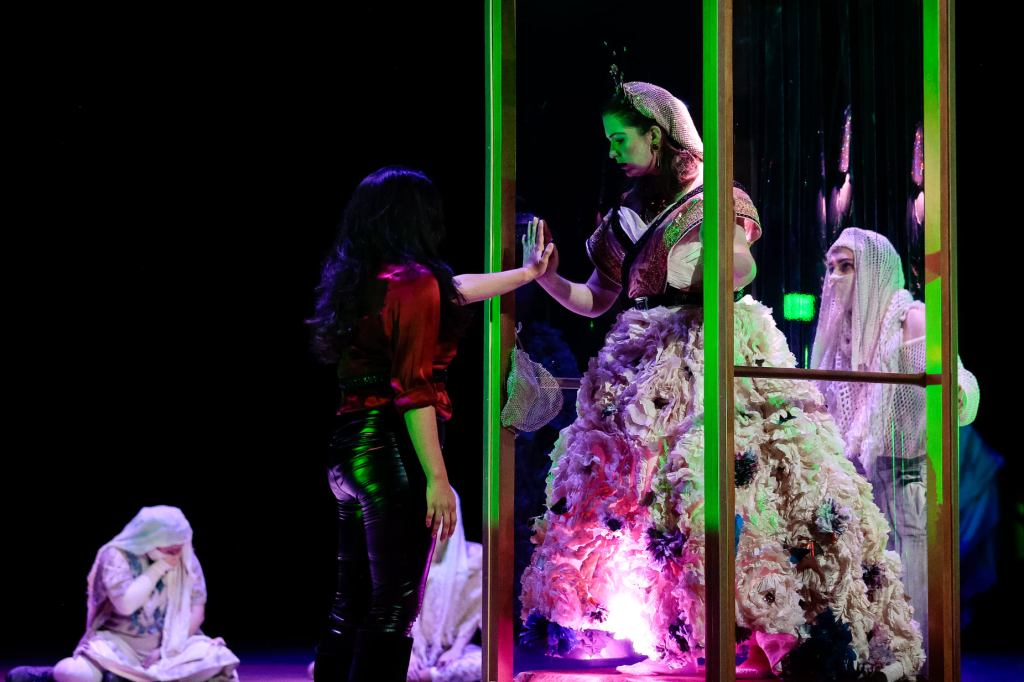
During the play, Medea cries out often for her homeland, her father, and her brother. Her greatest regret is severing ties; her greatest problem is that she does not belong anywhere. In that sense, I have a small but significant connection with Medea. I grew up as a Third Culture Kid, or TCK. My family lived in South East Asia when I was ages 7-10. Culture shock is difficult enough for adults, but when kids develop part of their personality and history somewhere else, they end up with permanent ties to both (or all) of the cultures they grew up in. As a kid, I wasn’t fully American and I certainly wasn’t fully Malay. I had parts of both cultures, creating a third one that my siblings and I lived in all by ourselves. I have experienced, and occasionally still do, a deep sense that I will never be understood and I will never fit in.
(Disclaimer: I am aware that my life has been one of privilege, and I will never truly experience a sense of being “the other”. I am grateful for the experiences that help open my eyes to the rest of the world, and I hope I will continue to be a student of and a friend to “the others” around me.)
Medea is now one of my favorite plays of all time. I am forever grateful to have played Medea, and I will probably always have more mulling thoughts about her.
You made it to the end, thank you! Are you a fan of any Greek tragedies? (Please share, I have hardly read enough.) What do you think of Medea’s character and arc? How have you seen the idea of the foreign or “the other” play out in your life or today’s world? Comment below!
 Audrey A McGee
Leave a comment